
Explore all 4 Conflict Archetypes Based on the Conflict Blueprint Quiz
Keep in mind, you are never just one thing. You will likely recognize parts of yourself in the other archetypes too. Different situations, relationships, and stress levels can bring out different patterns.
This archetype is not your identity. It is a protective strategy you learned over time. And the beautiful thing is: strategies can evolve.
The Art of REPAIR helps you move from automatic survival patterns toward more connected, confident, and intentional conflict.
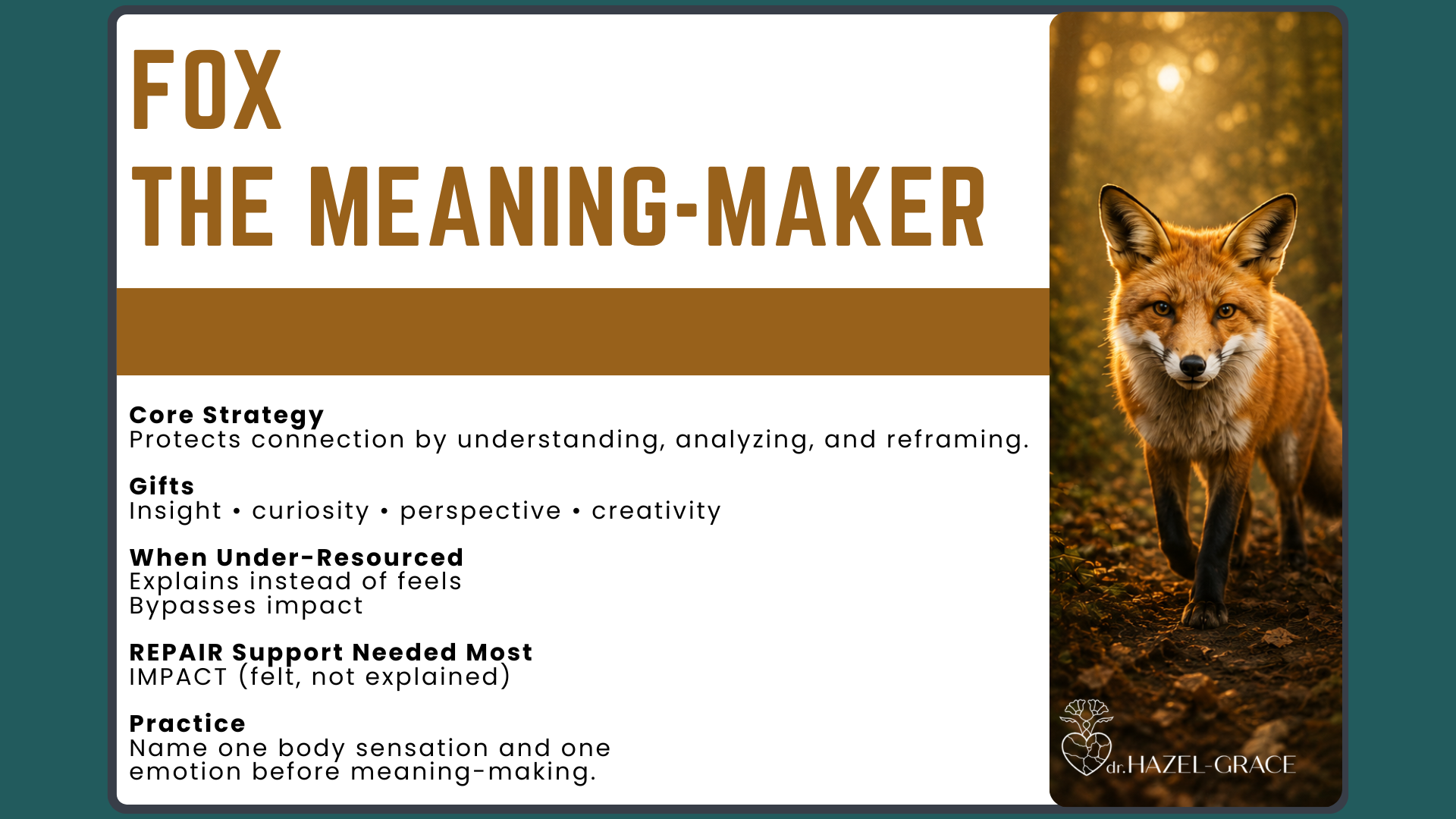
The Fox
The Meaning Maker
You are clever, intuitive, and highly adaptive.
When conflict or emotional intensity rises, your instinct is often to pivot, soften, charm, intellectualize, distract, or redirect the conversation. You likely learned early on that staying emotionally "light," flexible, or hard to pin down helped you maintain safety, freedom, or connection.
At your best, you are:
- playful
- creative
- socially intelligent
- emotionally perceptive
- adaptable under pressure
But under stress, your adaptability can become avoidance.
You may:
- minimize conflict
- change the subject
- disconnect from deeper feelings
- avoid difficult emotional conversations
- struggle to stay fully present in tension
Others may sometimes experience you as emotionally slippery or hard to fully reach, even when you deeply care.
Attachment Theory
The Fox often overlaps with avoidant attachment patterns.
You may deeply value freedom, flexibility, and emotional independence. Conflict can feel constricting, emotionally intense, or threatening to your sense of autonomy, leading you to redirect, distract, intellectualize, or move away from emotional vulnerability.
Your Greatest Growth Edge in The Art of REPAIR:
IMPACT
As a Fox, one of your greatest growth edges is slowing down and staying with emotional impact, rather than quickly reframing, explaining, distracting, or moving toward solutions.
The IMPACT step invites you to stay curious about both your experience and the other person's.
Learning this skill can help you:
- recognize and name what you're actually feeling
- stay present with another person's feelings without explaining them away
- deepen emotional intimacy
- move through conflict instead of around it
A Powerful Practice for You
When you notice yourself wanting to explain or reason, pause and ask yourself:
"What am I feeling right now?"
Then turn your curiosity toward the other person:
"What did that feel like for you?"
Your practice is simple: notice, ask, and stay.
You don't have to fix it, explain it, or make the discomfort disappear. Practice staying present long enough for both of your experiences to be felt and heard.
Take the next step in your Art of REPAIR journey by watching this free 20-minute Mini-Course.
Free Art of REPAIR Mini-CourseWant to learn about the other conflict archetypes?
Keep in mind, you are never just one thing. You will likely recognize parts of yourself in the other archetypes too. Different situations, relationships, and stress levels can bring out different patterns.
This archetype is not your identity. It is a protective strategy you learned over time. And the beautiful thing is: strategies can evolve.
The Art of REPAIR helps you move from automatic survival patterns toward more connected, confident, and intentional conflict.
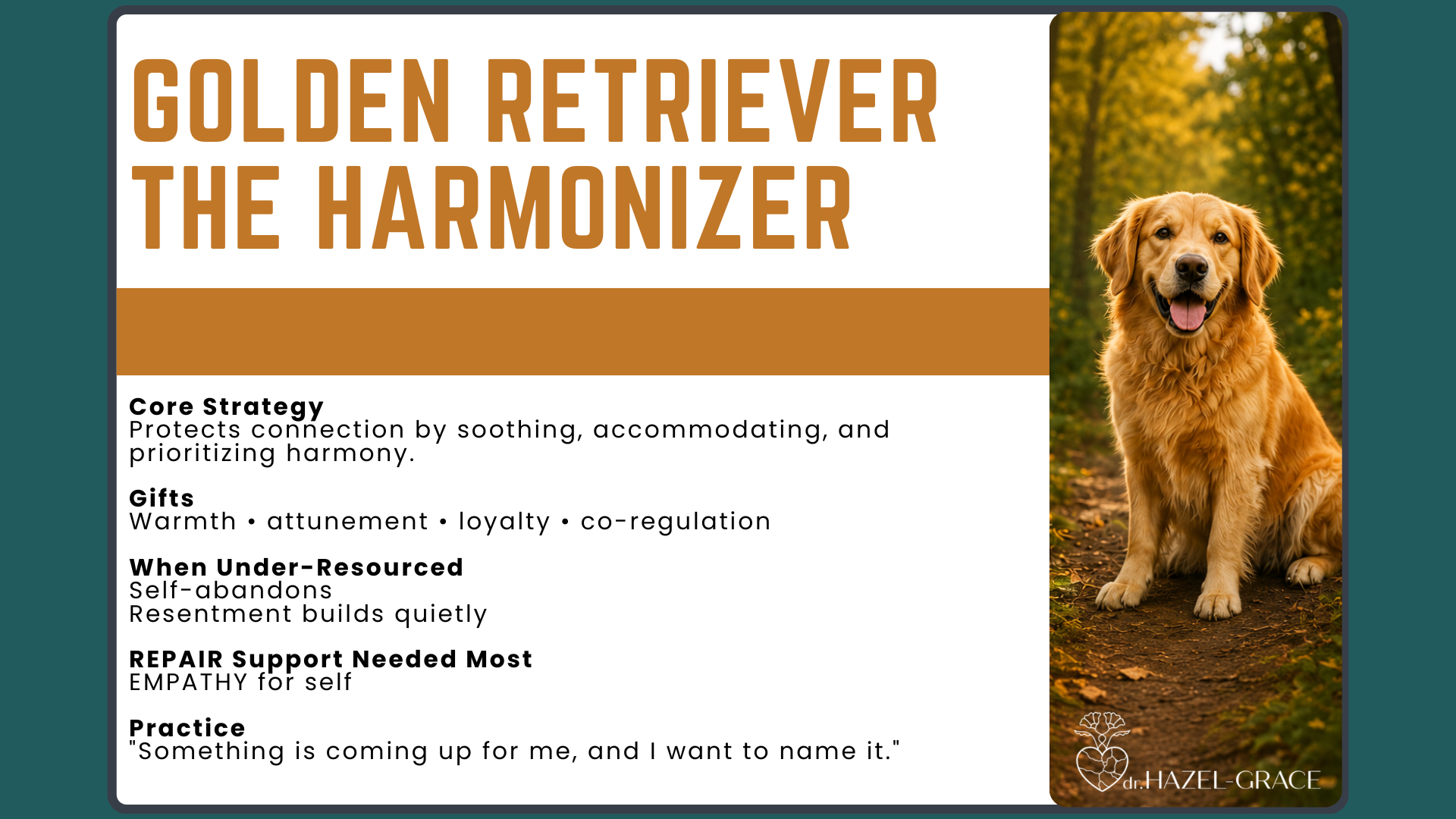
The Golden Retriever
The Harmonizer
You deeply value connection, care, and harmony.
When conflict arises, your instinct is often to smooth things over, accommodate others, or focus on everyone else's needs before your own. You likely learned that staying likable, helpful, or emotionally attuned helped preserve love and belonging.
At your best, you are:
- caring
- loyal
- empathetic
- generous
- emotionally attentive
But under stress, your care for others can become self-abandonment.
You may:
- avoid disappointing people
- suppress your true feelings
- apologize too quickly
- over-accommodate
- build hidden resentment over time
Others may experience you as loving and supportive, while not fully knowing what is actually true for you underneath.
Attachment Theory
The Golden Retriever often overlaps with anxious attachment patterns.
You may prioritize harmony, reassurance, closeness, and connection. Conflict can feel threatening to belonging or love, leading you to over-accommodate, people-please, over-function, or lose connection with your own needs in order to preserve the relationship.
Your Greatest Growth Edge in The Art of REPAIR:
EMPATHY FOR SELF
As a Golden Retriever, you may be highly attuned to how everyone else is feeling. Your growth edge is learning to offer that same care and attention to yourself.
When conflict arises, you may quickly focus on the other person's feelings, needs, or comfort. You might minimize your own hurt, tell yourself "it's fine," or move toward making things better before you've fully acknowledged what happened for you.
The EMPATHY FOR SELF step invites you to slow down and make space for your experience first.
Learning this skill can help you:
- recognize what you're actually feeling
- validate your own hurt instead of minimizing it
- identify what you need
- reduce people-pleasing and resentment
- care for others without abandoning yourself
A Powerful Practice for You
Before focusing on how the other person feels, pause and ask yourself:
"How did that feel for me?"
Then offer yourself the same compassion you would naturally give someone you love:
"Of course I feel this way. This matters to me."
Your practice: Pause. Feel yourself. Offer yourself care.
Your empathy is a gift. You deserve to receive some of it, too.
Take the next step in your Art of REPAIR journey by watching this free 20-minute Mini-Course.
Free Art of REPAIR Mini-CourseWant to learn about the other conflict archetypes?
Keep in mind, you are never just one thing. You will likely recognize parts of yourself in the other archetypes too. Different situations, relationships, and stress levels can bring out different patterns.
This archetype is not your identity. It is a protective strategy you learned over time. And the beautiful thing is: strategies can evolve.
The Art of REPAIR helps you move from automatic survival patterns toward more connected, confident, and intentional conflict.
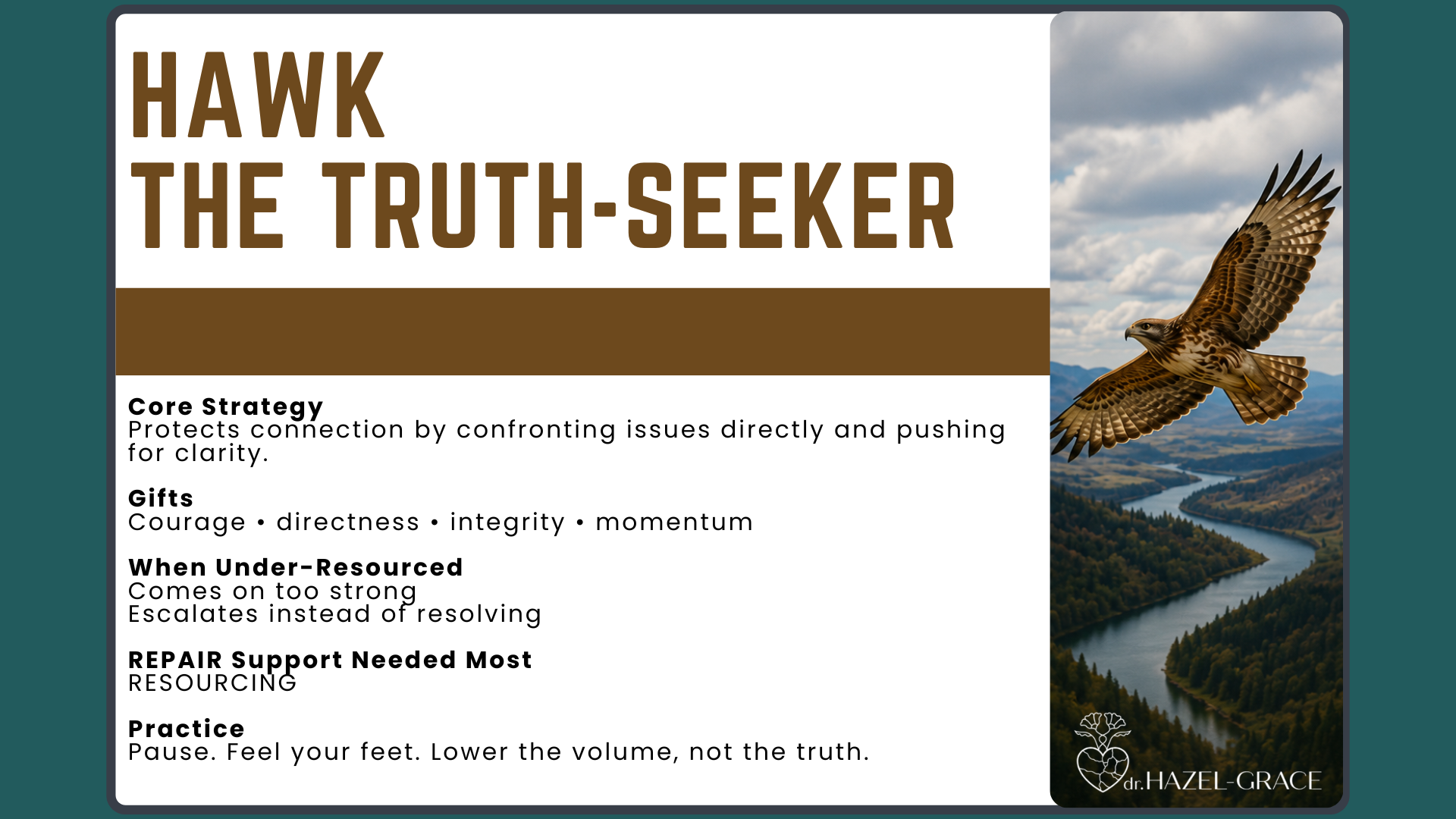
The Hawk
The Truth Seeker
You are highly perceptive and quick to notice what is not working.
When conflict arises, your instinct is often to move toward clarity, fixing, analyzing, or problem-solving. You likely learned that staying vigilant, competent, or "on top of things" helped you feel safe and prepared.
At your best, you are:
- insightful
- intelligent
- accountable
- direct
- solution-oriented
- protective
But under stress, your intensity can become overwhelming for others.
You may:
- become critical or controlling
- push for resolution too quickly
- focus more on being right than connected
- over-explain
- interrupt
- struggle to slow down emotionally
Others may sometimes experience you as intimidating or emotionally sharp, even when your intentions are good.
Attachment Style
The Hawk can overlap with anxious attachment, organized attachment strategies, or protective hyper-vigilance.
You may cope with relational uncertainty by seeking clarity, control, structure, accountability, or resolution. Your nervous system may become highly alert to potential problems, misunderstandings, or disconnection, leading you to move quickly toward fixing or problem-solving.
Your Greatest Growth Edge in The Art of REPAIR:
RESOURCING
As a Hawk, one of your greatest growth edges is slowing things way down.
When conflict arises, your nervous system may want to move quickly toward clarity, correction, problem-solving, or resolution. You may feel an urgency to address the issue right now.
But when you're under-resourced, your intensity can make it harder for the other person to stay open and connected.
RESOURCING helps you slow down enough to:
- notice your own activation
- soften the urgency to fix or resolve
- listen before responding
- make room for the other person's experience
- choose connection over speed
Slowing down doesn't mean avoiding the problem. It actually makes you more effective at resolving it.
A Powerful Practice for You
When you notice urgency or intensity rising, do not respond immediately.
Take a breath. Feel your feet. Notice what's happening in your body.
Then ask yourself:
"Can I slow this down by 50%?"
Your practice is simple: pause, resource, then respond.
You don't have to solve the conflict right now. Slow enough that both of you can stay in the conversation.
Take the next step in your Art of REPAIR journey by watching this free 20-minute Mini-Course.
Free Art of REPAIR Mini-CourseWant to learn about the other conflict archetypes?
Keep in mind, you are never just one thing. You will likely recognize parts of yourself in the other archetypes too. Different situations, relationships, and stress levels can bring out different patterns.
This archetype is not your identity. It is a protective strategy you learned over time. And the beautiful thing is: strategies can evolve.
The Art of REPAIR helps you move from automatic survival patterns toward more connected, confident, and intentional conflict.
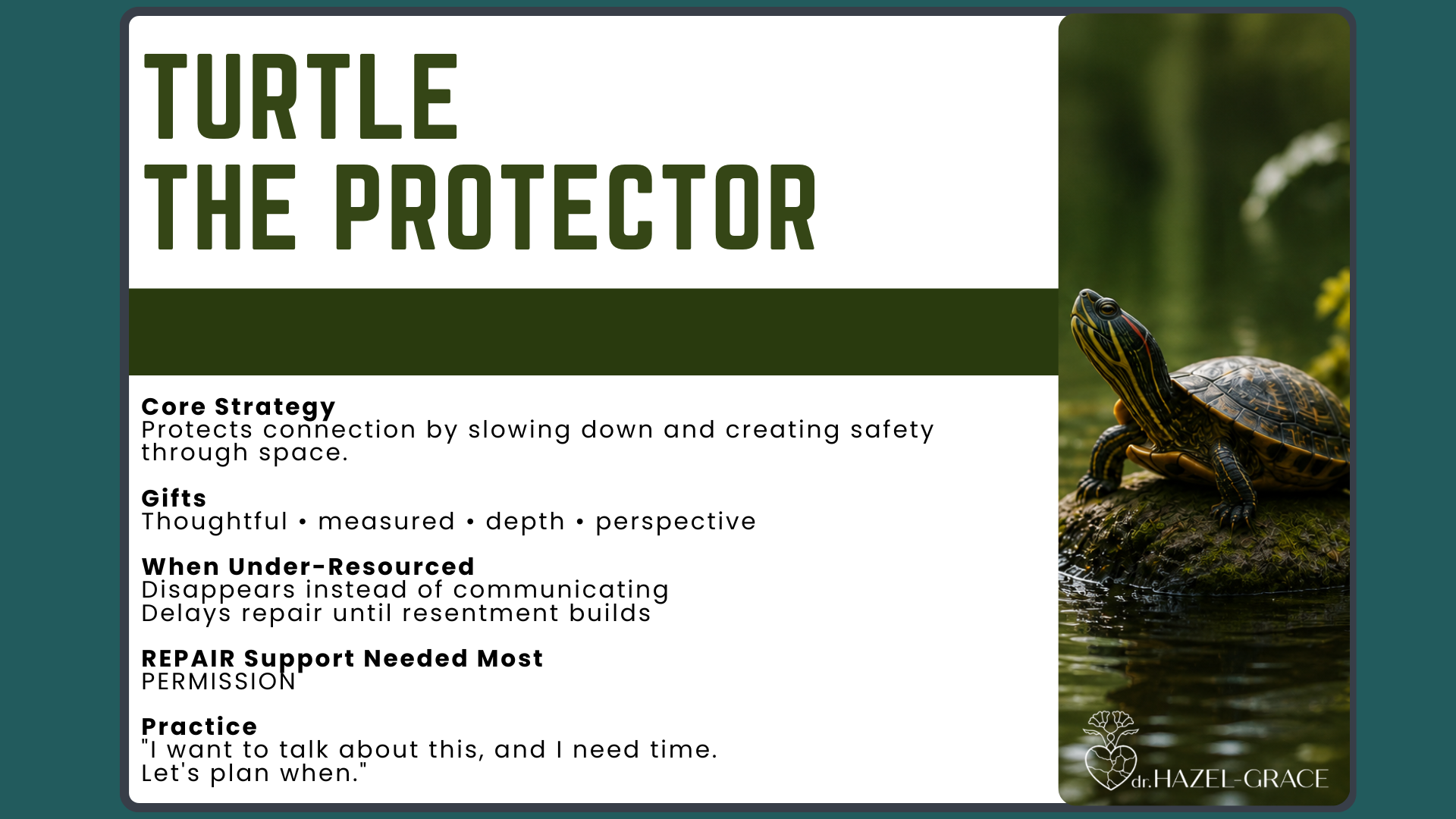
The Turtle
The Protector
You likely learned that slowing down, pulling back, or going inward helped protect you during conflict or emotional overwhelm.
When tension rises, your instinct is often to retreat, freeze, shut down, or disconnect internally. Conflict can feel emotionally flooding or unsafe for your nervous system.
At your best, you are:
- thoughtful
- grounded
- observant
- reflective
- emotionally deep
But under stress, your need for safety can become emotional disappearance.
You may:
- withdraw during conflict
- avoid hard conversations
- shut down emotionally
- need long periods of processing
- leave others unsure where they stand with you
Others may sometimes experience you as distant or unavailable, even when you deeply care.
Attachment Theory
The Turtle often overlaps with dismissive avoidant or fearful avoidant attachment patterns.
You may experience conflict as emotionally overwhelming or unsafe, causing your nervous system to shut down, withdraw, freeze, or retreat internally. Distance can feel safer than emotional intensity.
Your Greatest Growth Edge in The Art of REPAIR:
PERMISSION
As a Turtle, one of your greatest growth edges is learning to lean into repair instead of avoiding it.
Conflict can feel overwhelming to your nervous system, and pulling away may create a temporary sense of safety. But avoiding the conversation doesn't resolve the disconnection and can create even more distance over time.
The PERMISSION step gives you a way to approach difficult conversations while honoring your need for time, space, and preparation.
It helps you learn that you don't have to choose between having the conversation right now and avoiding it altogether.
You can take the space you need and stay committed to repair.
A Powerful Practice for You
When you notice yourself wanting to avoid a difficult conversation, practice creating a clear bridge back to it:
"I care about resolving this, and I'm not ready to talk about it right now. Can we come back to it tomorrow?"
The important part is naming when you will return.
Taking intentional space with a plan to return isn't avoidance. It's giving yourself the time you need to become more prepared and resourced for the conversation.
Your practice: Take space. Make a plan. Come back.
Take the next step in your Art of REPAIR journey by watching this free 20-minute Mini-Course.
Free Art of REPAIR Mini-CourseWant to learn about the other conflict archetypes?